What is Nirmata Archive
Nirmata Archive is a compression and archiving tool — built on top of the battle-tested
Zstandard (zstd) library — that adds one feature no ordinary archiver has: time-locked
archives. A .nir archive can be sealed so that it simply cannot be opened until the
Nirmata blockchain reaches a block height you choose, turning a folder of files into a
verifiable digital time capsule.
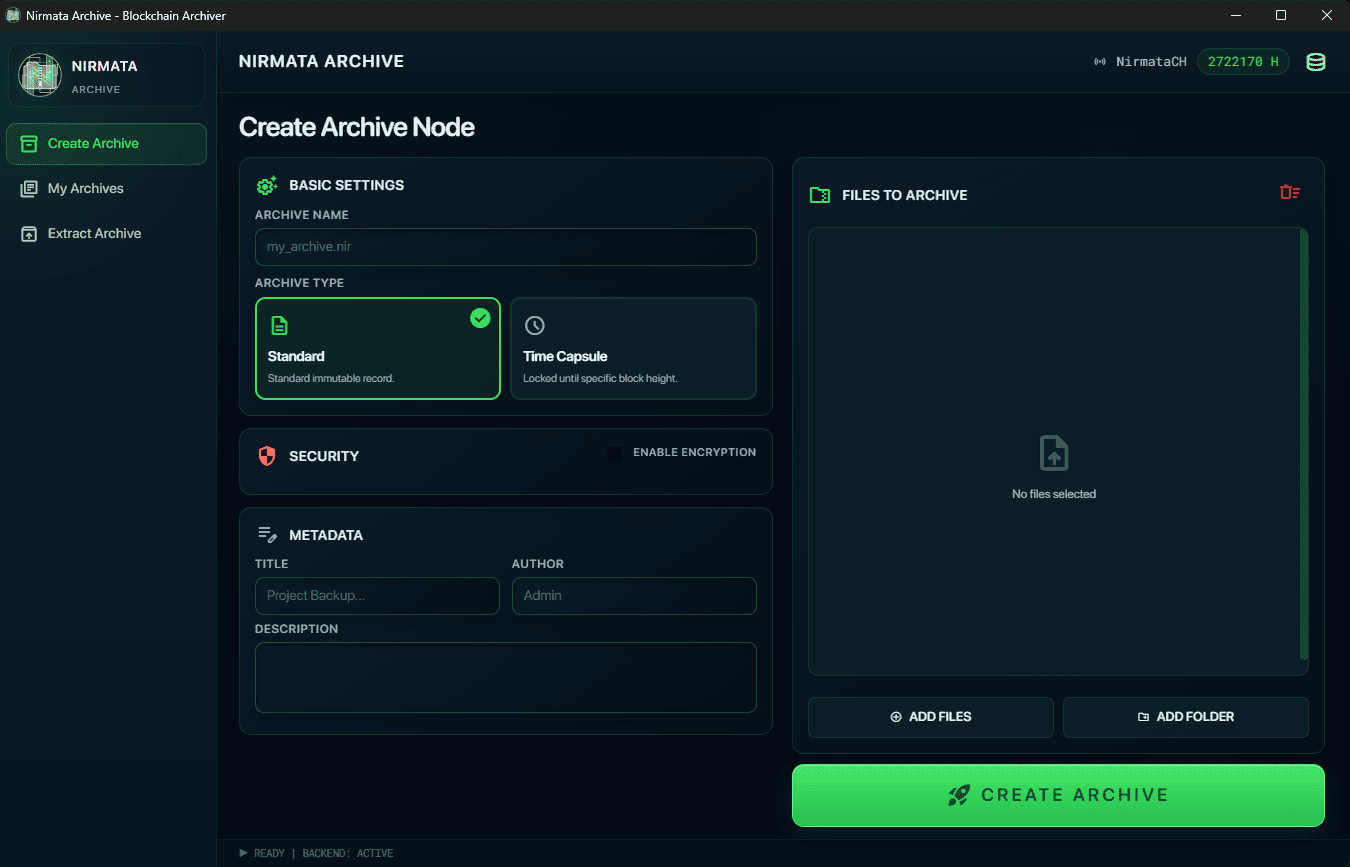
Standard archives
Used without a time lock, Nirmata Archive behaves like any modern archiver: it compresses your files with zstd, optionally protects them with an AES-256 password, and stores title, author and description metadata alongside the content.
Time capsules
When you create a Time Capsule archive, you set a target Nirmata block height. The archive stores that target height instead of anything that unlocks on its own:
- The lock isn't a promise enforced by the app — it's enforced by needing the blockchain to actually reach that height, which nothing on your computer can fast-forward.
- Nobody can open the archive early — not the person who created it, and not anyone who finds it. There is no override, backdoor or trusted third party who can unlock it sooner.
- Once the target height is reached, the archive unlocks automatically the next time it's checked — no further blockchain interaction, payment or permission is required.
Since Nirmata produces a new block roughly every minute, a target height also gives you a predictable estimate of the wait — the app's Current + 1000 shortcut sets a target about 1000 blocks out for you.
What it's for
- Digital estate planning — leave documents that only become accessible to heirs at a future date.
- Time-released disclosure — journalists, whistleblowers or researchers can seal material with a predetermined, verifiable release point.
- Business agreements — contracts or terms that should only become active or visible after a set point in time.
- Personal time capsules — messages or media meant for your future self.
How to use it
Nirmata Archive ships three ways to do the same thing:
- a desktop app (Windows, with macOS/Linux builds available from source) for creating, browsing and extracting archives visually;
- a command-line tool,
nirarc, for scripting and automation; - a web interface for managing archives from a browser.
All three read and write the same .nir format and talk to the same Nirmata blockchain
integration, so an archive created in one works in any of the others.